A live digital twin and AI control loop for carbon capture.
Our client is a climate tech company developing carbon capture and mineralization technology. Neuclon built the data and AI layer that connects the company's capture unit to a live model of the process.
Selected as the AI and data foundation for a climate tech ecosystem
Neuclon works directly with the company on its commercialization and operational strategy, and has shown how Neuclon OS can power its scientific Design of Experiments (DOE) process and help it scale.
Ecosystem partner
Admitted into the company's ecosystem as the AI and data foundation for its climate tech platform.
Scientific DOE enablement
Showed how Neuclon OS supports the company's Design of Experiments process, turning experimental data into faster, more confident decisions.
Operational scale-up support
Working alongside the company's commercialization strategy to help prepare its technology for scale.
Constraint-based architecture
Built to take in real-time sensor data and operate within hard, physics-defined safety bounds: the foundation for future autonomous control.
This is an active engagement, not yet a completed commercial deployment. Neuclon is positioned as the company's long-term AI and data partner as it scales from pilot to commercial operation.
Many interacting variables, one trade-off
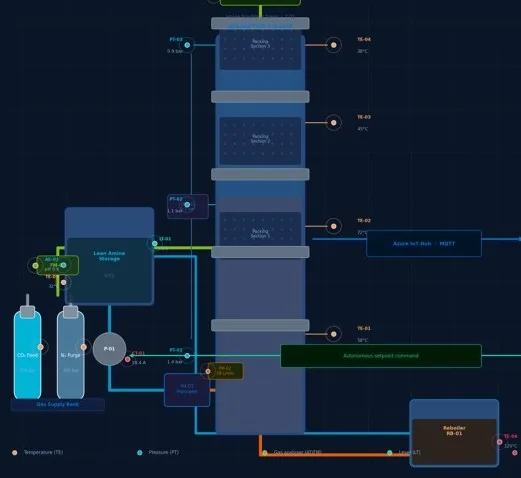
The company's test unit has a three-section absorption column, a solvent circulation loop and a reboiler that regenerates the solvent, monitored by 16 sensors. Raising the capture rate usually costs more energy, and the readings sat in separate instruments with no shared view of how the process was behaving.
Sensor to decision, on Microsoft Azure
- Connected all 16 sensors through an edge gateway to Azure IoT Hub over encrypted MQTT.
- Streamed and validated readings in real time with Event Hubs and Stream Analytics, and kept the full history in Azure Data Explorer.
- Built a live model of the unit in Azure Digital Twins, with every sensor mapped to its place in the process.
- Added physics-informed neural networks that respect the process chemistry and flow when predicting performance.
- Added a decision engine that recommends setpoint changes to raise capture rate while cutting energy use, with confidence thresholds and human approval before anything changes.
How a reading becomes an action
Unit sensors
16 points, MQTT
Azure IoT Hub
Device registry and telemetry
Event Hubs
Streaming ingest
Stream Analytics
Real-time validation
Data Explorer
Time-series history
Physics-informed AI
Performance prediction
Decision engine
Confidence checks
Setpoint
Approved change sent to the unit
From carbon to critical minerals
Neuclon and the company have also designed a joint AI approach for extracting magnesium from seawater and mineral ore, using the same physics-informed models to search process conditions far faster than running every experiment by hand.
The pattern carries straight into manufacturing: connect the sensors, build a trusted live model, and let AI agents recommend or make approved changes. It is how Neuclon OS works on a production line.